Hamumu Games, Inc. Hamumu Games, Inc.
 - Home - Games - Blog - Halloween - About - 
  It takes a village 01:47 PM -- Tue February 24, 2026  

I have invented a thing! I believe this is an entirely new feature in video games, and I'm really happy with the concept (it's not fully implemented, so who knows, maybe it is terrible, but I like it so far).

One of the arguments game players have with developers is about how creating alts (secondary characters) goes. As a simple example, in Diablo IV, there are altars to find, hidden around the world map, and each one gives you a little benefit (not anymore, though - that game just keeps changing all the time!). Originally, each character you created began with all of those altars unfound, and had to find them again. That was pretty annoying, because they were always in the same place, and there's no challenge attached to them, so after the first time, there wasn't anything interesting about finding them. It was just a chore. So players wanted their progress on finding those to carry over between characters, and thus it was done to placate the masses.

But there's also the other side of it - if too much of your progress is shared, creating extra characters is no fun, because there's no gameplay left! Diablo III is actually a good example of this. When you make a secondary character in that game, you can play the campaign again, but you can also play in Adventure Mode, which basically means "grind yourself to max level, there are no objectives". It's pretty boring and feels very aimless. But even I choose it over running the campaign again because the campaign just slows your leveling down so badly. I actually prefer the games that force you to re-run the campaign, like Last Epoch (my favorite!), because from moment to moment, there is something driving you forward, even if it's the same thing it was the last 100 times. Better than having nothing to motivate you!

So this issue of what does and doesn't carry over between runs is a complex one that requires balance and thought. Thusly have I invented Villages to give the player a level of control over this issue!


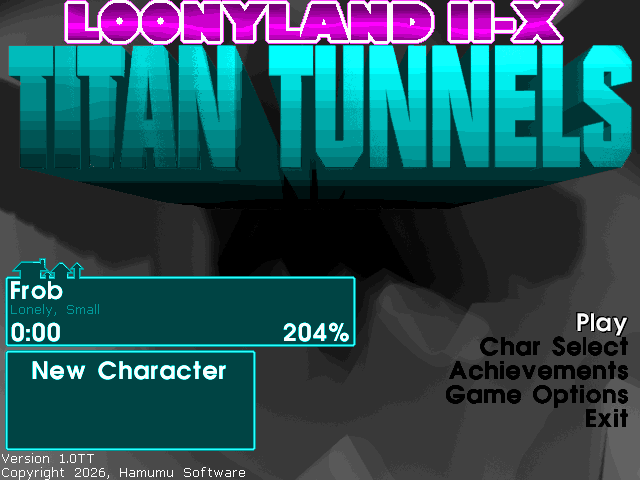
Behold the (still in progress, even the title is subject to change) title screen for this game. When you start the game for the first time, it asks you to name the village you are creating, which in this case is of course Frob (ignore that it's 204% complete...). If I were to click Play, I'd create a new character, named whatever I want, who is playing in the village of Frob. Then later, I can make another new character in Frob, or I can start a new village and start a new character there.

Some things are tracked on a per-character basis (like your level, the skills and talents you've unlocked, and your gear), while others are tracked on a per-village basis (like what quests you've completed, a shared item storage, and which exploration abilities - roidvanes - you have access to). This puts the power to the player - if you want to complete the quests again, make a new village. Or you can make a super-boosted alt in an existing village, who can grab powerful items from the shared storage and just level up and zoom to the bottom of the dungeon. Winning the game is a village-level activity, so it's like your collection of Woodies in the village is working together to defeat the titans. But you can certainly make new characters in the same village after you've won, if you want to play endgame activities like Madcap Mode.


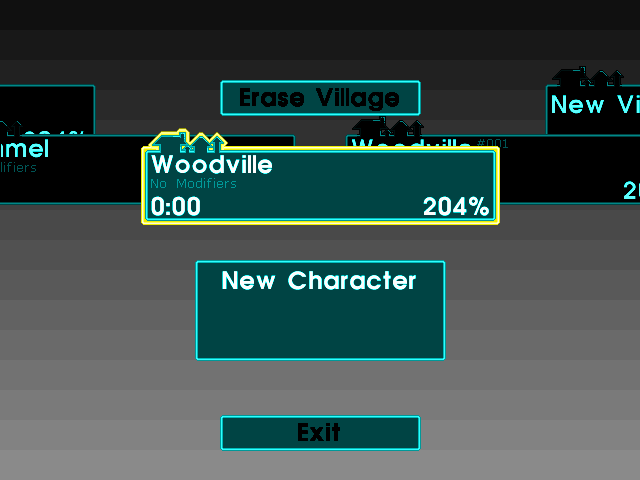
This picture is less exciting, but it's the Char Select screen, where you can make and delete new villages and characters, and swap between them to decide what you want to play right now.

So that's the core idea of the Village. I think it adds a fun element of freedom that other games don't have, though I obviously still have to determine which things are on the village-level and which are on the player-level, so you don't have full control over what resets between characters. There are also a few things that are game-level - you earn achievements game-wide, and just like in Loonyland 2, you earn new Modifiers by earning Achievements. You may also earn playable classes the same way, I'm not sure yet.

But speaking of what resets, another interesting element is that the random dungeon generation is based on the name of the village. So if you and I both name our village Woodville, we will both encounter the exact same dungeon and can share tips about where things are, or compete to speedrun it first. There is however a mechanism to reroll a specific floor of the dungeon - which is also predetermined. So if you reroll level 5 of your dungeon three times, and I do too (assuming we both named our villages the same), we will still have a matching level 5. Or I can reroll once, and you reroll twice, and now it's different. Does that make sense? It does to me, so get with the program.

You can also use the same name for two different villages (if you look closely, you can see a second Woodville in this picture, which says "#001" next to its name), if you like a certain layout, but want to start it from scratch.

And one last bit of fun - you know that in Loonyland 2, there were Modifiers you could enable on your character. You can still do that, and we'll have a bunch of the same ones and a bunch of new ones. But those are character-specific. We now also have Village Mods (see the first picture I shared, where it says "Lonely, Small"), which allow you to create a very different world you are playing in. Player mods are things like "spawn twice as many monsters" or "easy difficulty", while Village mods are things that necessarily affect everyone in the village, like "dungeon levels are smaller than normal" (which might be called "Small", don't you think?). "Lonely" is a crazy modifier for crazy people.

The goal of all of this is to make the game a sort of playground, where you can set the parameters and then just play in that space however you like. I probably should do a separate blog about how convenient and amazing it was that Diablo II (I've now name-checked 3 different Diablos in this post!) released a new update this month, after 25 years. Loonyland 2 is my take on Diablo II, so diving into that has really been an inspiration. This village feature is in fact something I thought of while grinding on one of my five Warlocks. Maybe we shall discuss that later!

Comment on this entry...Back to top!
  Kickin' the map into the river 03:54 PM -- Thu February 12, 2026  

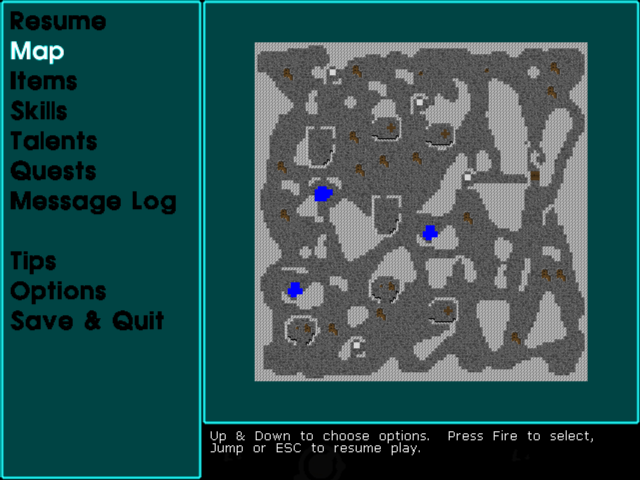
In Loonyland Second Story: Woody's Quest: The Ancient Tunnels of Yore: Hyper Fighting, I have gotten a version of map generation working:
There's a lot to go, but this is the basics. It produces maps that are more open than I would like. You probably notice some very very repetitive elements here. That's not a concern right now - it's just because I only have a few pre-made rooms at this point, so they repeat like crazy. Between those pre-made rooms is randomly generated squiggliness (which then gets 'decorations' like the brown dirt patches and little wall chunks - also very repetitive at this point). I'm pretty happy with this so far, but it does need tweaking so it's not just a wide-open area with the special rooms just sort of scattered in it.

And of course, you can see this is the pause menu, so there is going to actually be a mini-map you can look at! It will be nicer than this, but again, it's a start. I wouldn't have made this so early, except I needed a way to visualize the map generation, so it just made sense. And of course it will fill in as you explore, not show you the whole thing at once.
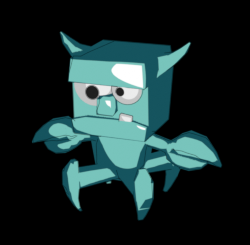
And here's a fun new element! I started making the first non-Woody creation for this game. It's currently called an Iceguard, just cuz. Could be called a Snow Crab but it's ice, not snow. It isn't just another enemy for variety, it serves a specific purpose in your quest.
1 commentBack to top!
  Woody's Quest 10:56 AM -- Wed February 4, 2026  

Speaking of Loonyland X-2: Challenge Of The Tunnels: The Withering Tree: Axial Tilt Omega, Woody is now fully animated in-game and running around! Provided you only use a single axe and nothing in your off-hand. In reference to the art layering system from the last post, I think what I've settled on is simplified, which is always the right answer: a full different animation set for each combination of gear. This is the easiest to implement, the easiest art pipeline, and possibly even uses less data. That's because with layered art, I had to make frames for every possible animation you could do, with every weapon, even if that weapon can't do that animation, just to keep the animations aligned. Obviously those could be blank frames, but that would also be a pain, to have to blank those frames each time. This new method means with each type of gear he only has the actual animations that that gear can do, which cut his total animation frames to about 1/3 of what I had (multiplied by the number of different gear combos, but the other method also needed that, just potentially trimmed down to only the different pixels between items). It has its own challenges, but overall I think it's the simplest.

If all that sounds confusing, imagine trying to figure it out in the first place! But in other confusing complexities, here's a fun screenshot from my current work:
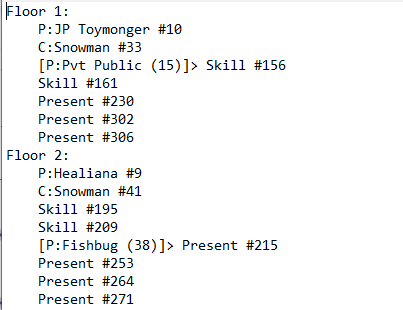
The game currently outputs that text file on startup as a test. This is my Roidvane Sequencing Tool (I am absolutely trying to make 'fetch' happen, since 2011!). It's kind of like a view one level more abstract than the map generator - it is figuring out what items should go where on each floor of the dungeon, and what other items should block your access to them (i.e. Pvt. Public is the guy who gives you the Pine Key, so to get Skill #156, you need to have rescued him first, because Skill #156 is behind a Pine Door). Then the map generator's job will be to produce a physical layout that implements this plan. Note: there aren't 306 presents or 209 skills - each collectible just has a unique ID.

It was a very fun process figuring this out once I actually sat down to do it. Each item has a preferred depth (so you gain certain vital features early on, and there's a general progression of keys and puzzle types, and there are some endgamey elements that will normally appear way at the bottom), and the deeper an item belongs, the more likely it is to be blocked by a roidvane, and it is more likely to be blocked by a roidvane obtained at an earlier dungeon level than it is on (so you don't usually need an item from the 50th floor to get something on the 1st floor... but sometimes you do!). Of course it's all random, so your dungeon may have some real oddities like not getting Phileas (who is very important!) until way down deep, but that's part of the variety.

The trickiest bit is that it then has to do a check for dependency loops (need the Pine Key to get the Mitten Key, but the Pine Key is behind a Mitten Door, uh oh!). Fingers crossed that I got that right, as it's kind of hard to prove it's not just been lucky in my tests. We'll find out when testers play it!

The parenthetical numbers are the floor that the roidvane is found on, so as you can see above, you have to reach level 38 to rescue Major Fishbug before you can get the present on Floor 2. But that's because, on the first few floors, there's no room for you to have gotten roidvanes above them. And yes, that is something that is handled to a degree! The first 4 floors of the dungeon have greatly reduced chance of needing any roidvanes at all, everything just sits out in the open. By the bottom of the dungeon, almost everything is behind some kind of barrier, but of course by then you have nearly every roidvane so it's not really an impediment.

How this all translates into an actual physical map you explore is the next big challenge, and I'd say probably 14 to 93 times as difficult as this was. I've swung back and forth between pure generation (traditional maze/dungeon algorithms that lay it out one block at a time) and putting together hand-built map segments. I have settled on the latter, but the hand-built rooms might be connected by algorithmic tunnels (which allows the rooms to be of arbitrary size and positioning, rather than evenly spaced on a grid), we shall see. At this stage of the development, lots of the work is just plain mental, imagining these systems in the abstract so I can break them down into something that can be created. That's how I spend my time going to sleep every night, just arguing with myself in my head. It's weird.

And always looming over it all is the terrible fear of how bad the non-Supreme level editors are... maybe porting that over is worth the effort.
1 commentBack to top!
Copyright 2021-2025, Hamumu Games Inc.